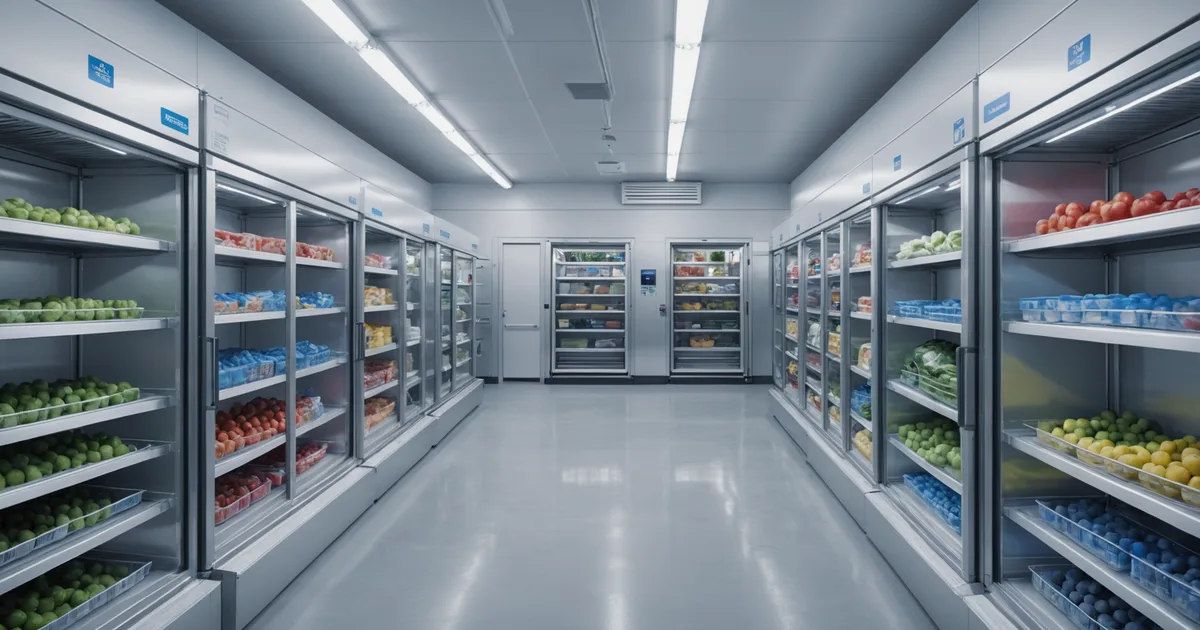
A 12-minute gap between cold-room exit and trim-station entry caused the largest freshness loss found by a berry processor after three months of temperature logging. During that interval, product sat at ambient dock temperature, averaging around 58 degrees Fahrenheit in summer. It left cold storage at 34 degrees and reached as high as 41 degrees before reaching the line. Downstream trim sensors never tied that thermal history to sort rates observed 60 to 90 minutes later.
This pattern appears often in fresh-food plants. Cold rooms usually have temperature logs, door-open alarms, and setpoint checks. The handoff zone between storage and line is more often watched only by the receiving-area operator on duty.
Why Cold-Room Handoffs Go Unseen
Fresh-food cold-chain control is commonly treated as storage and transport. Is the cold room at temperature? Is the refrigerated transport unit running? Both questions have binary answers and simple instrumentation.
The space between cold storage and processing behaves differently. It is neither a storage area nor a transport unit, but a movement interval whose time and heat exposure depend on move speed, staging temperature, an open loading-dock door, and the queue at trim-station entry.
No single system owns this interval, so it is rarely instrumented. Cold storage records its area, and line sensors record theirs. The handoff remains an unmeasured gap.
What Product Encounters During the Handoff
Post-harvest thermal science is established. In the 32-to-50-degree Fahrenheit range, each degree of warming increases cellular respiration and ethylene production. For leafy greens, warming by 4 degrees for 10 or more minutes can accelerate visible quality loss and later increase sort rejections.
Stone fruit and berries respond more sharply. Surface softening starts above 45 degrees Fahrenheit. A short excursion above 50 degrees during a handoff, repeated across multiple batches, reduces shelf life even when sorting shows no obvious defect. Consumer complaints and retailer returns may appear later.
Production yield does not always reveal this loss. Product can pass the optical sorter and pack correctly while the sensor still sees no quality defect. The decline appears later, away from the floor, as shorter shelf life. That loss never enters the plant's production data.
How Repeated Handoffs Add Up
One shift can include several cold-room handoffs: morning intake from overnight storage, mid-shift replenishment from receiving, and end-of-shift return of unprocessed product. Each brings separate heat exposure, and the impact builds across a shift and a season.
Mixed-product facilities can see large differences in handoff time and temperature delta. A leafy green moving through a 55-degree staging area for 8 minutes receives less thermal stress than a berry lot held in a 62-degree dock area for 22 minutes while an operator waits for a forklift.
Neither event sets off an alarm in the plant's existing instrumentation. Both can alter downstream sort performance and shelf life. The link stays hidden because monitoring does not treat the handoff as a distinct product event.
How to Instrument the Handoff Zone in Practice
Transition monitoring does not mean replacing existing sensors. Most plants already monitor cold-room temperature and sometimes receiving docks. The missing layer is data integration linking those readings with processing-line results.
A transition-aware system needs three inputs: the time product leaves cold storage, temperature readings from one or more points along the route, and the downstream line state when that product reaches processing equipment.
The third input is the difficult one. The plant must identify when a specific lot enters the trim or sorting line, using barcode or RFID tracking, or disciplined movement logs at every handoff. Many facilities have the first two inputs but not the third. Without it, temperature records remain isolated from yield results.
How It Relates to Downstream Sort Rates
Once handoff temperature is tied to downstream sorting, a relationship can emerge within a few weeks of consistent logging. Product entering at a given temperature and reaching the line after a given dwell time tends to show a repeatable sort-rate pattern. Warmer or longer handoffs are followed by higher grade-out rates 60 to 90 minutes after processing starts.
This pattern does not establish causation in every case. Harvest maturity, mechanical calibration, and belt speed relative to product density also affect sort rates. Still, the signal is consistent enough to make handoff temperature a controllable yield-planning variable rather than background ambient exposure.
When a handoff runs longer or warmer than the product type's established baseline, the lot's sorting calibration should be checked before processing starts.
What This Does Not Claim on Cold-Chain Compliance
This is not a claim that most facilities violate cold-chain requirements. A plant may maintain strong FSMA traceability, complete cold-room and transport temperature logs, and a rigorous HACCP program while still lacking visibility into the 10 to 20 minutes product spends moving to the processing line.
Cold-chain compliance frameworks focus on storage and transport. They do not generally record the handoff as a separate measurable event. Compliance therefore does not provide complete thermal visibility from cold storage through the first processing step.
A facility may be fully compliant and still spend freshness budget in the handoff zone each shift. Compliance is a floor, not a ceiling.
What Full Thermal-Path Tracking Changes
With handoff data in the operating view, the morning debrief gains information most plants lack. The team can compare the prior shift's sort results with its handoff conditions, find events that precede elevated grade-out, and change dock procedures, staging time, or processing order.
The handoff zone is small, and one event looks minor beside activity on the processing line. Its importance comes from repetition: it occurs every shift for every lot moving from cold storage to the line. Effects build over a harvest season. When freshness is both product and margin, a 12-minute interval can quietly create weeks of cumulative monitoring blind spots.
That is the operational gap Terrantic was built to close.