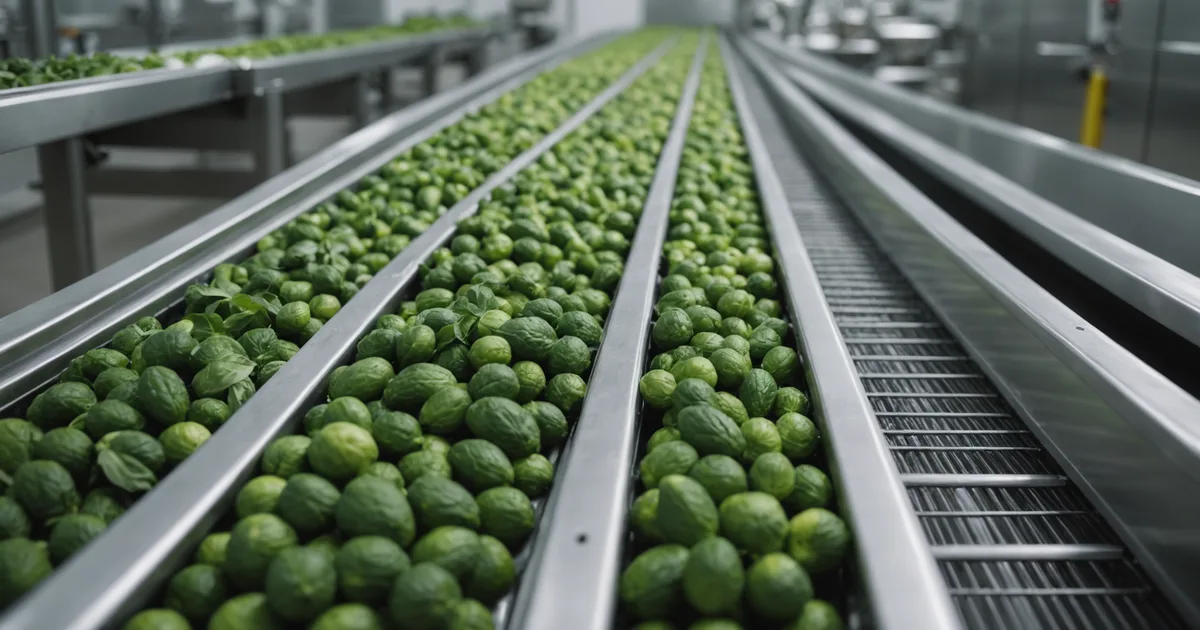
During an 8-hour shift, a leafy greens processor running four lines found a 3.4% yield gap in the morning debrief. That 3.4% meant approximately 800 pounds of sellable product. No single failure explained it. The total combined 12 minutes of weak sorting calibration after a product changeover, a 20-minute cold-room transition four degrees above target, and three periods when line speed ran far enough ahead of feed rate to stress product at trim. Each event was small. Together, they mattered. No one saw the pattern while the shift was underway.
The Shift-End Total Is Not a Live Signal
Fresh-food plants commonly capture yield at two points: operator-entered batch records and automated totals from checkweighers or scale systems. Both are period totals. A batch yield of 78% shows output against input. It does not show when yield was good, when it fell, or what the line was doing in each phase.
This is not mainly a missing-technology problem. Most plants have sensors, PLCs reading conveyor speed, optical sorters logging throughput, and checkweighers capturing pack weights. The data is present. It is separated into systems that report on logging schedules, not at the pace required for operating decisions.
Once the yield figure arrives at shift end, it is a record of the past. It can explain events, but it cannot alter a process still in motion.
How Loss Builds Across a Shift
Yield loss in fresh-food processing seldom arrives as a dramatic breakdown. Conveyors keep moving and sorters keep running. Loss instead grows from conditions that each appear to sit within normal limits.
Feed rate creep shows the pattern. As harvest product changes in density or moisture, a belt speed that fit at 6 a.m. may run slightly fast by 10 a.m. Product stress rises gradually. Sorter rejection moves from 8% to 10% to 12% over two hours. Each step may look like ordinary variation. The combined result does not.
Calibration drift in an optical sorter creates another path. Sorters begin with parameters set from the first product sample of the day. When harvest changes in color, size distribution, or surface moisture, a threshold that fit startup may reject acceptable product by midshift. This is not a failed sensor. It is a context mismatch the sensor cannot identify alone because upstream conditions are outside its view.
Cold-room transitions form a third category. Product moving into or out of cold storage gains ambient heat during transfer. Transition duration and temperature delta depend on loading-dock dwell time, staging-area temperature, and movement through the transition zone. A transfer 6 degrees above target for 15 minutes can accelerate freshness loss before product reaches trim.
Three Layers Hide Loss
The hidden-loss pattern has three structural layers.
First, every plant data source reports only its own domain. The optical sorter records decisions, the checkweigher records pack weight, and the temperature logger records cold-room readings. None sees the others in the moment. Viewed alone, a rejection spike looks like a product-quality issue. In context, it may show the sorter correctly responding to a lot from a warm transition.
Second, reporting intervals do not match event intervals. Yield-affecting line events unfold over minutes, while shift reports combine hours. When the combined number exposes a problem, many contributing events have ended, compounded, or been replaced by later line states.
Third, the human loop takes too long. A line walk catches obvious failures, but not gradual drift across four lines at once. Tracking every relevant parameter across a facility requires more attention than one person can sustain through a full shift.
The Window for Recovery
When an event begins at 9:15 a.m. and the shift report is reviewed at 6 a.m. the following morning, the recovery window has been closed for 21 hours. Nothing remains to recover. The batch is finished, packed, and possibly in cold storage awaiting distribution.
When an event begins at 9:15 a.m. and a targeted alert reaches an operator at 9:18 a.m., 60-to-90 minutes remain to adjust sorting, lower feed rate, or request a transition-temperature recheck. The batch is still running, so yield may still be recovered.
That is the divide between reactive reporting and live monitoring. The issue is not better data after the event. It is receiving the relevant signal while conditions can still change.
In pilots at early-access facilities, we ask one question before instrumenting a line: what is the longest you have gone without knowing about a yield-affecting event? Answers range from two hours to a full shift. Each facility had data systems. The missing pieces were integration and timing.
Shift Reports Still Have a Role
Shift reports remain necessary. A good end-of-shift summary helps track production over time, find patterns across days or weeks, and build operating knowledge that improves setup procedures. This is not an argument to discard the debrief or stop batch reporting.
The narrower point is that a debrief-only loop gives up every recovery opportunity during the shift. A debrief explains what happened. It cannot change what is about to happen during the next 8 hours of production. Those are separate jobs, and one report cannot perform both.
Why the Pattern Remains
Fresh-food plants are not running without modern systems. They use SCADA, sensor networks, and experienced operators. Yield remains hidden until shift end not because data is absent, but because its integration and timing are insufficient.
Detecting feed-rate drift requires data from three systems: the belt-speed sensor, sorter-throughput log, and checkweigher output. None exchanges that information with the others in real time. Without synthesis during the shift, the event stays unseen. The data is there; the connection needed at that moment is not.
The hours between what the plant knows and what is happening on the floor are the interval where yield is lost.